Posts

Riding on a Loose Rein, Continued

This post is in response to a comment from White Horse Pilgrim. Thanks WHP, for stopping by and for your great comment. I am so glad you brought up this subject, as it is something I didn’t address in my previous post, but probably should have! White Horse Pilgrim said... This is a most interesting discussion. I'm curious to hear your opinion about riding outside the arena. I was taught by some stereotypical (and sometimes rather fierce) English instructors to ride on a firm contact and to drive the horse forward into it, and was told to trail ride in that style too! However it was a fatiguing way to ride, and didn't seem to help the horse, though many English horses seem to need that contact to push against. I began to ride out on a loose rein using a curb bit after spending time with riders from the American West, and my horses (which were not English riding horses) performed well on the trail. I like them to be able to balance themselves when out riding for hours, espec...
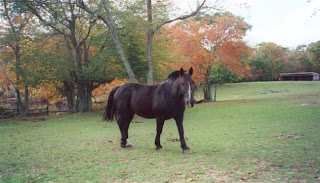
Riding on a Loose Rein

Everywhere you go in the hunter/jumper world, it seems you’ll find a majority of trainers, judges and riders advocating riding horses – and particularly show hunters – on a loose rein. I have never shown my own horses this way, and never will, despite the fact that most judges seem to require it if a horse is to pin in a class, even though the USEF Rule Book states that “ light contact with the horse’s mouth is required ,” (HU128 Under Saddle and Hack Classes,) as opposed to no contact. Of course, there are times when a loose rein is beneficial, but knowing when and where it is appropriate is key to good horsemanship. And from what can be witnessed at any show barn or showground across the country, it is clear that good horsemanship has become unfashionable, to say the least. When is it appropriate to ride on a loose rein? · When first mounting and settling in (if the horse is quiet) · When cooling out or resting · While executing a “free walk” (thou...

For the Horses

Image
Equine Rescue, Continued... In my short lifetime, I’ve been called a lot of things -- not all of them complimentary. But one thing I have never been accused of is being someone who doesn’t care about horses. But that’s just what happened recently on another blog in which commenters were trying to come up with solutions for the growing neglect and abuse of horses. In offering an alternative viewpoint to the prevailing discussion, I was summarily told to leave the discussion and told I clearly didn’t love horses. It took me by surprise to say the least. And it hurt. I’ve dedicated my life to the welfare of horses. I’ve ruined my health over it. But if all of this has been done in less visible ways, well, I’ve never wanted to be a hero or be applauded for what I consider to be my responsibility as a horse owner and a human being, not an altruistic display for the world. But now I’m left in the position of feeling like I have to defend myself against such an attack, when I s...

Big Bad Horses...?

I haven't had the time to write a new post in a while, but when a friend passed this video on to me, and I felt the need to comment on it. Maybe you've already seen this on YouTube, the Chronicle of the Horse, or other blogs. It's getting a lot of rave reviews from amateurs and professional horsemen alike. And, certainly, at first glance, it would appear impressive to the untrained eye. But I’ve taken a more critical look at the rides presented here, and I’d like to play devil's advocate to all those who offer such glowing praise. As someone who has specialized in training (and retraining) so-called "problem" horses, I know firsthand what a problem horse looks like and how to effectively deal with one. And what I see in this video concerns me. I’d be interested in hearing more from other horsemen about their experiences with problem horses, and the people who claim to train them. Some background on my experience: as a junior and young adult rider, I di...

"Natural Horsemanship" Part 2

Case in Point: Client from Hell When I was still training professionally, I encountered a client who was every serious trainer’s worst nightmare. She was an utter novice with little to no experience with horses who decided one day to purchase a poorly bred grade horse from a picture on the internet. As if that wasn’t enough to make one cringe, this horse was still a foal; weaned and shipped cross-country at three months old. And this owner, who had no experience, apparently decided she’d become his surrogate mother. But, unlike an equine mother – who instills discipline and knowledge in her offspring – this owner simply coddled this foal as if he were a puppy for four years in her backyard until he was dropped abruptly on my doorstep. You see, this owner was an armchair equestrian . With no experience and no education in riding or training horses – much less raising and producing youngstock – she undertook the huge responsibility of developing a young horse through his most form...

Some Notes on “Natural Horsemanship,” Part 1

The advent and popularity of natural horsemanship is, for all intents and purposes, proof that “what’s old is new again.” Let’s face it: thinking horsemen have become fairly jaded after witnessing the meteoric rise of mediocre horsemen in our equestrian disciplines. So-called experts, these individuals are motivated largely by the commercial emphasis on competition-for-its-own-sake , and it reflects in their philosophies and attitudes towards horses and horsemanship. They have been hawking methods, philosophies and practices which have left many of us with a bad taste in our mouths. As concerned equine enthusiasts, we were hungry for something with more substance and less show, more compassion and less ego; something more in tune with our enlightened sensibilities and our love and respect for our animals. Out of this vacuum, a handful of horsemen emerged claiming to “discover” alternative methods of training and riding horses which would “revolutionize” the world of riding a...

Rollkur: Training… or Torture?

Image
  About the head of a truly great horse there is an air of freedom unconquerable. The eyes seem to look on heights beyond our gaze. It is the look of a spirit that can soar.   ~John Taunter Foote Rollkur. You see it everywhere. Among dressage, jumper, hunter, and even western pleasure trainers, this particular method has become the mainstay of many riders today. But what is it, what it is intended to do, does it work, and is it ethical? Rollkur has just been redefined by the FEI as “hyperflexion of the neck.” It involves a combination of extreme longitudinal and lateral flexions of the neck with a pronounced break behind the poll. At times the nose will touch the chest or shoulder. Proponents of this method claim that rollkur stretches the topline, lifts the back and supples the horse, and therefore is a desirable technique for developing the equine athlete. These proponents do not, however, distinguish between “good” and “bad” stretching. After all, a torn ligamen...

Riding Instructors: Can’t live with them… Should you live without them?

Finding an instructor or trainer you can live with is no small feat. Like many riders, I have struggled to find a compatible trainer that I can respect; who respects me and my horses; who understands our abilities as well as our limitations. A largely self-taught rider, I have been very fortunate in that I have always had a variety of horses of all types, ages and dispositions to work with, which amounted to a kind of hands-on laboratory of horsemanship. Adding to that, I had in my early years of riding a few decent trainers and employers who respected my abilities enough to leave me on my own to both train these horses and be trained by them. It was probably this experience of independence and self-reliance which most shaped my perceptions of the trainers I have come into contact with over the years, most of whom I haven’t even a shred of respect for. I’ve personally seen the benefits of self-education, of trial and error, and of working without a net, but this is not for everyone...