Posts

"On the Bit" - Getting Started

“ON THE BIT”—FIRST PHASE: LONG AND LOW KEY POINTS: ·       Flexing ·       Loosening ·       Lengthening FIRST STEPS: LOOSENING In this fist phase, the main priority will be to release any tension in the jaw, neck and poll, and thereby relax the topline, which will encourage the horse to naturally adopt a long and low frame on his own as opposed to an inverted and braced one. WHAT DOES THIS ACCOMPLISH? To accomplish this, one uses a single, simple rein aid: the “ Direct (Leading) Rein. ” The basic theory behind using the leading rein to get the horse stretching and relaxed in his topline is based on a technique advocated by Boucher.   He understood that, in order to raise the head and invert the topline, the horse has to brace the muscles on both sides of the neck as a pair.   Bringing the head to one side with a gentle leading rein (he employed a lifting hand for th...
Following Release Follow-Up Questions

AoifeTheRambler asked some great follow-up questions in a comment on my previous post , so I thought I’d take a few minutes to answer them because I think they are important issues we all deal with when using the following/automatic release.  While I don’t claim this is the definitive ruling on any of these issues, in my opinion and based on my experience, this is how I’d address them: Q:    “I used to keep my shoulders back (along with most of my torso) no matter what back in the age of the crest release, but now I curl up slightly when I go forward. Is this due to the release, and if so, do you have any tips to fix it without interfering with my release?” A:   Most of us are taught to ride with an arched back and square shoulders to go along with the crest release.  And with the crest release, this kind of position is possible because the elbows are bent and the support of the upper body rests in the hands, not the hips and back. ...

Learning the Following Release Over Fences

Image
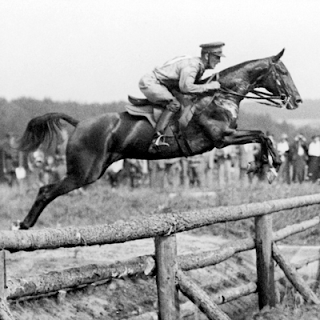
Many of us agree that the ideal way to help our horses jump their best is to use the following--or automatic--release.  But this is obviously easier said than done.  So, what are some ways to practice and perfect this method?  Here are a few I’ve found helpful in my own riding and when helping students to wean themselves off the crest release: 1) Flat work: Probably most important is to practice a secure and balanced half-seat and two-point/jumping position at all gaits for at least some portion of your ride every day.  Once your legs, hips, abs and back are strong enough, practice this while concentrating on keeping a fluid, mobile arm; shoulders, elbows, wrists and fingers should all remain relaxed, independent and capable of following the horse's head at all times.  Once you're able to maintain a secure position while keeping a soft following hand in jumping position, practice this without stirrups. 2) Hill work: Chances are there i...

Happy B-Day Nate!

Image
4/9/11-- Just a quick post to say Happy Birthday to my "Tater."  He's 16 today, which means he's been with us for 12 years now!  Above is a picture from the first day I ever saw him.  He was 4 year old DWB fresh from Holland sent to me for training by a breeder I worked with.  For those who don't know how he got his name, his reg. name is "Napoli," but I worried that his inevitable nickname "Nappy" could also mean either a diaper or a recalcitrant horse - neither particularly flattering.  But we also had a running joke that he had the attention span of a gnat... and 'gnat' turned into the slightly more flattering "Nate."  But of course that has since degenerated into "Nate-o-potato" or just "Tater." I can't get over how little he's changed since then - just as big and goofy as ever ;-)  Once he arrived and I started working with him, I just fell in love with him and ended up buying him for myse...

Open Letter to “Practical Horseman”

 “If I didn’t have the pulley rein…”  - Stephanie Simmonds, Practical Horseman, March 2011 …uh, you’d have to learn to ride?  Doh. These days I seem to read your publication mainly as an exercise in voluntary frustration.  Until now, I have never felt the overwhelming need to respond to any of the many asinine articles I find there for two simple reasons:   1. Who has that kind of time?  Nearly every article in your magazine contains something ridiculous or just plain offensive, and people need to sleep and eat ; and 2.  It would be a futile effort, as I know my voice is one among a minority of riders out there who genuinely care about good horsemanship, not just ribbons.  Honestly, I don’t know why I continue to subscribe.  I suppose it’s more akin to rubbernecking a car wreck on the highway.  I read your magazine much in the same way some people read the “National Enquirer”—for the shock value and a few lau...

Molly

Image
A lot of horse blogs are doing a valentines’s day tribute to their horses with stories about how they came to fall in love with their equines.  Normally I’m kind of anti-valentine’s day on principle, but this year I feel like I have to take a moment to remember the day I met my best friend of 18+ years, a dog named Molly.  All those years ago, I went to visit my aunt who worked with an aussie rescue and was keeping a young dog at her home until she could be placed.  I had no intention of getting a dog of my own at the time, but the moment I walked into her living room, this little black and tan dog with white paws and a freckled nose leapt over the side of her pen, ran over to my side and rested her head on my knee.  She was adorable and sweet and she wouldn’t leave my side the entire visit. I was convinced she must have been trained to do that or something, but my aunt swore to me the dog had never done anything like that with anyone else before....

Hay Net Helpers

Image
  I'm a big fan of slow feed nets for my horses.  Not only do they slow down my hungry hippos, keep them busy and their bellies full until morning, they also help reduce waste.  I used to simply hang a net or two in each stall, but filling them got to be a chore, so I fixed half the net to the bars to make them easier to fill and then tied the pull-rope off to close them.  That worked well for a while until I saw a neat idea on another site and decided to give it a try. Someone had woven two poles through either side of the top of the net so it could be opened and closed like a sandwich bag.  I bought a few Freedom Feeder nets because of their size and square shape, got some dowels from the hardware store and made some up.  I used the big sturdy snaps I normally hung my hay nets with, which have a 1" ring at one end, to slide over the ends of the dowels.  They were secured to the wall with some screw eyes.  Then all I had to do to fill a net w...

More about "On the Bit": Calm, Forward and Straight

--> I’ve been thinking about the role and responsibility of the seat and leg aids in “on the bit” and whether “on the bit” is dependent on those aids from the rider or simply influenced and/or refined by them at a later stage of training.  I got to wondering about all of this because all of the horses I start are given considerable training from the ground long before they are ever backed, and that ground work continues in addition to ridden work as a part of their training for the rest of their careers.  An important part of that ground work for me is introducing the horse to contact with the bit and the rein effects before riding in hopes of developing the best possible relationship between horse and hand, while also developing the correct form and balance needed for their later ridden work. Contrary to popular belief, longeing is not just a way to give horses a little exercise when you’re too busy to ride (though that’s not a bad thing) and it shouldn’t be the way ...

What it Means to be "On the Bit"

I love getting my www.thehorse.com e-mails, as they are usually filled with interesting news and information for concerned horse owners/trainers like me. So I was a bit dumbfounded by this recent article title: Study: Horses Prefer Less Rein Tension It stated: “According to a new study by European equitation scientists, horses might prefer to avoid rein tension rather than just get used to it. And beyond a certain force threshold, rein tension can cause conflict behavior . To make the most of training and to keep the horse's mouth sensitive, riders need to know when to apply less rein tension, generally when the horse displays conflict behavior.” When I read the title of this study I thought to myself, “uh, no shit, Sherlock.” Like a previous study stating, “ Study: Shelter-Seeking Behavior Most Common in Poor Weather Conditions ” this was not a major newsflash. But it was a topic near and dear to my training, so I read on and, to my great unsurprise, t...